Rei Kawakubo and Commes Des Garcons


Rei Kawakubo  (born 11th October 1942 in Tokyo) is a Japanese fashion designer, founder of Comme des Garçons. She is untrained as a fashion designer, but studied fine arts and literature at Keio University. After graduation, Kawakubo worked in a textile company and began working as a freelance stylist in 1967.

Rei likes to have input in all the various aspects of her business, rather than just focussing on clothes and accessories. She is greatly involved in graphic design, advertising and shop interiors believing that all these things are a part of one vision and are inextricably linked. She is known to be quite reclusive and media shy, preferring her innovative creations to speak for themselves.


In 1973, she established her own company, Comme des Garçons (French for "like boys") Co. Ltd in Tokyo and opened up her first boutique in Tokyo in 1975. Starting out with women's clothes, Kawakubo added a men's line in 1978. Three years later, she brought her first collection to Paris. Bathed in black, it featured strong but conflated silhouettes that honored provocation over fit.
Collections are designed in the Comme des Garçons studio in Aoyama, Tokyo and are made in Japan, France, Spain and Turkey. Comme des Garçons has a dozen boutiques and approximately 200 vendors around the world, Signature Comme des Garçons boutiques are located in London (Dover Street Market), Paris, New York City, Beijing, Hong Kong, Seoul, St. Petersburg, Tokyo , Kyoto, Osaka Fukuoka.


Comme des Garcons specializes in anti-fashion, austere, sometimes deconstructed garments, sometimes lacking a sleeve or other component. Her garments are primarily in black, dark gray, and white, often worn with combat boots. The materials were often draped around the body and featured frayed, unfinished edges along with holes and a general asymmetrical shape.
Junya Watanabe, Kawakubo's former apprentice, started his own line in the early 1990s and has attained much attention in the fashion business in his own right. Junya Watanabe and Tao Kurihara  have started their own sub-labels under the Comme des Garçons name to much acclaim. Both were also involved in designing for the casual women's knitwear line 'Comme des Garçons Tricot'.


Rei designs have inspired many other late designers like the Belgian Martin Margiela and Ann Demeulemeester, as well as Austrian designer Helmut Lang. Comme des Garçons have collaborated with various other labels over the years including Fred Perry, Levi's Converse All Star, Speedo, Nike, Moncler, Lacoste, Cutler and Gross, Chrome Hearts, Hammerthor, S. N. S. Herning, Louis Vuitton and many others. Comme des Garçons and H&M collaborated on a collection which was released in the fall of 2008.

Yuna Yang


Yuna Yang is a NewYork based fashion designer who loves to convey the concept behind her work, viewing each piece as a form of art to be shared, rather than simply to be sold. Her designs draw from her personal fascination with immersing herself in divergent cultures. After completing her B.A. in Fine Arts from Ewha Women's University in Seoul, Korea in 2001, she moved to Milan for a design course at Instituto Marangoni. While in Italy, her aesthetics, attention to detail, and Eastern perspective on Western fashion caught the eye of designer Alviero Martini, and she was honored with a commission to design evening dresses for Milan Fashion Week 2002. Later in 2006, Ms. Yang further honed her technique and received a second B.A. in Fashion Design from Central Saint Martins in London. There, she was privileged to work with designers Ann Sofie Beck and Clements Ribiero (2005 – 2006).


Yuna Yang's label, YUNA YANG COLLECTION was founded in December 2008. After a market test of her Spring/Summer 2010 collection in September 2009, she had her debut show of her Fall/Winter 2010 collection on February 10th, 2010 during New York's Fashion Week at the Arario Gallery. Her debut collection was widely praised and well received by the fashion critics, and it was featured on the cover of the April 6, 2010 issue of Women's Wear Daily. WWD called Yuna Yang "a sure winner just out of the gate with her charming Louise Brooksinspired first collection of lacy frocks, beautifully tailored cashmere coats and perfectly draped silk jersey sheaths".


“Shaped by the era of the 1960’s housewife, Yuna Yang’s 2011 collection linked the traditionally feminine with the luxurious,” Each piece wa sophisticated and elegant, yet by no means overdone. The line was made up of classic silhouettes, embellished with eye-catching sequins and black lace. Made in rich chiffons and silks, her showing included detailed draping and playful ruffles in shades of blue, pink, gray, black, and even ivory. This collection truly embodied the spirit of old Hollywood glamour.

Marc Jacobs

Marc Jacobs was born on the 9 April, 1963 in New York City and grew up in Teaneck, New Jersey. He is an American fashion designer and the head designer for Marc Jacobs. Marc Jacobs held an early interest in fashion, working as a stock boy at Charivari, a NYC clothing boutique while attending the High School of Art and Design. He graduated in 1981 and quickly enrolled at the Parsons School of Design. Not one to be held back, Jacobs had already designed and sold his first collection (of hand-knit sweaters for Sketchbook) before he had graduated from Parsons.
 In 1997, Jacobs was appointed Creative Director of luxury French fashion house, Louis Vuitton, where he created the company's first ready-to-wear line.  At Louis Vuitton, he has been triumphant in revamping the famous accessory line and has collaborated with the likes of Steven Sprouse, Julie Verhoeven, Takashi Murakami and Richard Prince.


In 1986 Jacobs designed his first collection with the Marc Jacobs label. The following year, Jacobs received the distinct honour of being the youngest designer ever to be awarded the fashion industry’s highest tribute
The company has expanded to more than 60 stores worldwide and currently produces six fragrances, 2 eyewear collections, a line of watches, shoes, handbags, accessories, jewellery,  sunglasses and a table top collection with partner Waterford Wedgewood that launched in December 2006.


Although Marc Jacobs is the creative director for both Louis Vuitton and his own line, he has been very successful in creating completely different images within the two labels. As a designer, it is difficult to develop two completely different lines but Marc Jacobs seems to have been successful in doing so. Louis Vuitton and Marc Jacobs offer similar products, displaying completely different images.
Louis Vuitton is a more sophisticated, higher-end label whereas Marc Jacobs is a more casual (still high-end) designer label with a street-savvy approach to fashion. Marc Jacobs has a number of popular lines including Marc by Marc Jacobs, Stinky Rat and Little Marc (children’s line). Each line has seen significant amounts of praise from audiences and fashion critics. Marc Jacobs remains one of the most popular fashion icons of both the 20th and 21st centuries.

Vivienne Westwood

 Vivienne Westwood  (born Vivienne Isabel Swire on 8 April 1941, in the village of Tintwistle, Derbyshire) is a British fashion designer and business woman, largely responsible for bringing modern punk and new wave fashions into the mainstream.
She became well known in the 1970s when, with Malcolm McLaren the rock music entrepreneur, she opened a shop in London that became the focus of the punk rock movement. She gained international recognition in the early 1980s with her Pirate and New Romantics look. Vivienne Westwood has played a vital role in the emergence of Punk Rock in the 1970s and has gone on to become one of the most original and influential designers of our time.


Westwood has five exclusively-owned shops; three in London, one in Leeds, and one in Milan. Franchise stores are located in Liverpool, Newcastle, Glasgow, three in Manchester and most recently, in FH Mall, Nottingham , and in Blake Street, York.


Today, Westwood’s a global empire comprises the semi-couture line Gold Label, a ready-to-wear line Red Label, Vivienne Westwood Man and the diffusion line Anglomania. She has perfumes – Boudoir, launched in 1998 and Libertine, launched in 2000 – as well as successful ranges of knitwear and accessories. British Designer of the Year twice, in 1990 and 1991, honoured with the Order of the British Empire in 1992 and made Dame Vivienne Westwood in 2006, she has drawn uncommonly wide acclaim from the extremes of the street and the establishment.
Vivienne Westwood signature style is Provocative, awe inspiring, avant garde, unique, rebellious, and a true original. Her designs combine a fearless unconformity with a sense of tradition. She is renowned for her gentle parody of Establishment styles, her use of very British fabrics such as Harris tweed and tartan, her re-use of historic garments such as the corset and crinoline. Westwood's creations are brilliant, subversive, and incredibly influential. She is unquestionably among the most important fashion designers of the late 20th century and beyond.


Jil Sanders


JIl Sander has always been fascinated by the original concept of high street fashion, and offering her attractive, clean cut clothes to everyone, it felt like a worthwhile challenge to globalise quality at affordable prices and to engage in a company that has the power to reach people on a global scale. Her collaboration collection with Uniqlo was good match as the design teams share the same visions.
She was determined to start her own line, as she wanted a sense of grown up beauty with smart unfrivolous cutting, comfortable quality with a dynamic look. She felt that more attention needed to be paid to how the clothes looked on the body instead of what surface decoration when onto the body.
She felt that to be able to make clothes that would sell to lots of people that she would have to master the basics, understanding pattern cutting, fabric and its properties, these techniques she constantly develops thought her fitting, all the information learnt is then poured back into the pattern until the pattern becomes a fashion statement in its own right.
She pays very high attention to the detail within her designs by investing time and huge effort during the toiling stage, constantly fitting the toil. (Sometimes up to 5 times) to ensure a flawless sculptured silhouette and unconditional ease for the wearer
When it comes to style she feels that women are becoming confused about what style to go for with the constant changing of trends i.e. sexy kitten, provocative or lady. She felts that in the long run you are better of choosing a dignified demure will fitting style. Without the basic she feels it must be hard to start an original look, as they is no starting point to work from.  Thus leading to many looks being outrages, eccentric and over the top.
Jill sanders looks is very much about the purely of the design, with them being will fitted and made from high quality material.  Her design should work as a smart frame or a quiet background where some think else can take centre stage. This is why she has a very loyal client base that keeps coming back.
Jill sanders are also a very private person rarely ever giving interviews.


1968 Opened her first store
1975 Launched her line
1979 branched out into cosmetics and fragrances
1997 started a menswear collect
2000 sold her company to Prada but it failed famously clash of egos, only lasted four months
2003 return to her company 
2004 left over designer drifferents
2008 started design for her collaboration with Uniqlo


Lily Hiene


Lily Heine graduated from Central St Martins master course and won the Harrods design prize for her final collection.
Her graduate collection was made up entity of the same beige fabric; he designs were constructed with layered panel placed onto the figure to add depth. Picasso sketches of women inspired her collection where her explored their figure by drawing them with the use of square, curves and other shapes. Once the garment were placed on the model they seemed to become living status because of the motion from the panels creates, it is also because of the stony classic texture from the fabric, that traces and contour the body which causes the animated look when the models move.
Some of the garment have been sold to Topshop and are now being make for A/W10, therefore bring couture to the high street, as each layer for the panels is hand stitched to the bottom layer making it a very labour intense collection. The collection has been described as “modern couture”, Lily is very interested in the relationship between couture, art and comermiatily.
            She now hoped the be able to work as an in house textile designer and designing freelance on the side.
 

Ann Demeulemeeters


Signature look: an unstructured jacket cinched at the back, shown this season with a draped and cowled blouse and narrow cropped trousers, it border son evangelical
Wants to stay away from the merry-go-round of main stream fashion,
“my life is so mixed with my profession that I don’t know were I begin or end”
One of the Antwerp six,
Works mostly in black and white with flashes of colour,
High attention to detail
Like to build long term looks which withstand the test of time rather then passing trends,

1959 Born, Belgium
1978/81  Royal Academy of Fine Arts, Belgium
1982 Golden Spindle Award, Belgium
1987  First collection Fall/Winter 1987-1988
1988 Introduction of the shoes and accessories collection 
1992 First show in Paris
1996 First menswear collection is shown together with the women swear during Paris fashion week
1996Attribution of the Culture Award by the Belgian government
1999 Opening of Ann Demeulemeester store in Antwerp
2004First men show in Paris
2006 Opening of Ann Demeulemeester stores in Tokyo and Hong Kong
2006 Introduction of the jewellery collection  2007 Opening of Ann Demeulemeester store in Seoul 


FETISHISTS


A fetish (derived from the French fétiche; which comes from the Portuguese feitiço; and this in turn from Latin facticius, "artificial" and facere, "to make") is an object believed to have supernatural powers, or in particular object that has power over others. Essentially, fetishism is the attribution of inherent value or powers to an object.


Sexual fetishism, or erotic fetishism, is the sexual arousal a person receives from a physical object. The object of interest is called the fetish, the person a fetishist who has a fetish for that object; ; "common male fetishes are feet, breasts, legs, hair, shoes, and underwear".  Initially, the concept of fetishism was used by the Portuguese to refer to the objects used in religious cults by the West African natives.  Arousal from a particular body part is not to be confused with fetishism because it is classified as partialism, which refers to a sexual interest with an exclusive focus of a specific part of the body.  Partialism is categorized as a paraphilia (A paraphilia involves sexual arousal and gratification towards sexual behavior).


Most of the material on fetishism is in reference to heterosexual men, with most of the objects fetishized being highly feminine items such as lingerie, hosiery, whip and high-heeled footwear. In contrast, for homosexual men most of the objects fetishized tend to be highly masculine.


  • In the 19th century Karl Max appropriated the term to describe commodity fetishism as an important component of capitalism nowadays, (commodity and capital) fetishism is a central concept of Marxism.
  • Later Sigmund Freud appropriated the concept to describe a form of paraphilia where the object of affection is an inanimate object or a specific part of a person.


Cultural Origins:  Early-Mid 1950s United States
Typical Instruments:  Guitar - Double bass - Drums - Piano, vocals
Mainstream Popularity: Popular in 1950s, revival in early 1980s. Rockabilly continues to have cult following at the present time


 The term rockabilly combines “rock” (from rock 'n' roll) and “billy” (from hillbilly music of the 1940s and 1950s) that contributed strongly to the style's development. Other important influences include western swing, boogie woogie, and rhythm and blues. While there are notable exceptions, its origins lie primarily in the Southern United States.  The influence and popularity of the style waned in the 1960s, but during the late 1970s and early 1980s.
There was a close relationship between the blues and country music from the very earliest country recordings in the 1920s.  During the 1930s and 1940s, two new sounds emerged when  Bob Wills and his Texas Playboys combined country singing and steel guitar with big band jazz influences.  After blues artists launched a nationwide boogie craze starting in 1938, country artists began recording what was known as “Hillbilly Boogie,” which consisted of "hillbilly" vocals and instrumentation with a boogie bass line.


The Maddox Brothers and Rose were at "the leading edge of rockabilly with the slapped bass that Fred Maddox had developed".  Others believe that they were not only at the leading edge, but were one of the first Rockabilly groups, if not the first, followed in the 1950s such artists as Zeb Turner, Bill Monroe (the “father of Bluegrass”), Merle Travis, Hank Williams, Hank Snow, Tennessee Ernie Ford and Curtis Gordon.  In the early 1950s there was heavy competition among Memphis area bands playing a mix of covers, original songs, and hillbilly flavored blues.


Sun Records was a small independent label run by Sam Phillips in Memphis, Tennessee.  As well as recording and releasing performances by blues and country musicians, Phillips also ran a service allowing anyone to come in off the street and for $3.98 (plus tax) record himself on a two-song vanity record. One young man who came to record himself as a surprise for his mother, he claimed, was Elvis Presley.  According to Phillips, “Ninety-five percent of the people I had been working with were black, most of them of course no name people”.  Elvis fitted right in. He was born and raised in poverty and was surrounded by people who had very little in the way of worldly goods.


PSYCHOBILLY


Stylistic origins:  Blues, garage rock, rhythm and blues, punk rock, rockabilly, rock and roll
Cultural origins: Late 1970s England
Typical instruments: Guitar, double bass, drums
Mainstream popularity: Popular in England and Europe in the 1980s. Gained popularity in the United States in the late 1990s and early 2000s.


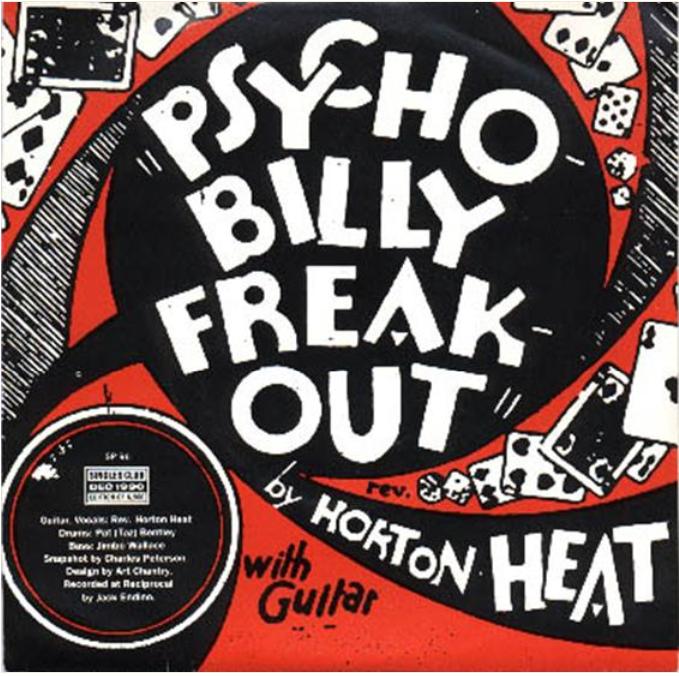
The term "Psychobilly" was first used in the lyrics to the country song "One Piece at a Time", a Top 10 hit for Johnny Cash in the United States in 1976.  The rock band The Cramps appropriated the term from the Cash song and described their music as "Psychobilly" and "rockabilly voodoo" on flyers advertising their concerts.  They have since rejected the idea of being a part of a psychobilly subculture, noting that they were just trying to drum up business.  It wasn't, they said, meant as a style of music.


Psychobilly is a fusion of rock music that mixes elements of punk rock, rockabilly, and other genres.  It is often characterised by lyrical references to science fiction, horror and exploitation films, violence, lurid sexuality, and other topics generally considered taboo, though often presented in a comic or tongue-in-cheek fashion.  Psychobilly gained underground popularity in Europe in the early 1980s, but remained largely unknown in the United States until the late 1990s.  Since then the advent of several notable psychobilly bands has led to its mainstream popularity and attracted international attention to the genre.


Psychobilly musicians and fans often dress in styles that borrow from 1950s rockabilly and rock and roll, as well as 1970s punk fashions. Men often wear brothel creepers or Dr. Martens boots and shave their heads into high wedge-shaped pompadours or quiffs, military-style crops, or mohawks.  Women of the psychobilly subculture frequently model their fashions after B-grade horror films and hot rod culture.